
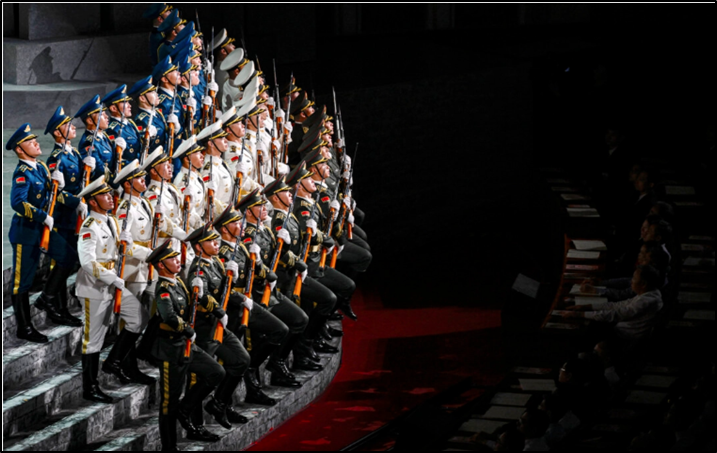
China’s People’s Liberation Army (PLA) has recently witnessed a sweeping anti-corruption crackdown that has resulted in the expulsion of four top generals from China’s parliament, part of a broader purge set in motion under President Xi Jinping’s leadership since 2012. This ongoing campaign, which has intensified sharply since 2023, exposes deep-rooted corruption, internal power struggles, and Xi’s drive to consolidate control over the military at a time of escalating geopolitical challenges.
According to SCMP, On 12 September 2025, China’s National People’s Congress (NPC) Standing Committee announced the dismissal of four senior PLA generals from their legislative roles, a rare and severe disciplinary action highlighting the seriousness of the graft allegations. The generals expelled were Wang Chunning, commander of the People’s Armed Police (PAP); Wang Zhibin, disciplinary chief of the Rocket Force; Zhang Lin, head of the Logistics Support Department under the Central Military Commission (CMC); and Gao Daguang, political commissar of the CMC’s Joint Logistics Support Force. These figures occupied pivotal posts linked to military logistics, discipline, and strategic missile forces, making their removal a significant disruption to PLA senior leadership.
Wang Chunning, the most senior among them, holds a full general rank and commanded critical forces responsible for Beijing’s defense and internal order. His rapid rise and subsequent fall underscore the anti-corruption campaign’s penetration into the highest echelons of the military. The Rocket Force, responsible for China’s nuclear and strategic missile capabilities, has been under particular scrutiny, with disciplinary leadership like Wang Zhibin’s dismissal indicating concerns over integrity in this sensitive arm.
The Scale and Context of Xi Jinping’s Military Purge
This wave of dismissals is part of the largest purge of PLA generals since Mao Zedong’s era, extending beyond mere corruption allegations to include ideological purity enforcement and elimination of potential rival factions. Since Xi Jinping assumed leadership in 2012, he has vigorously used anti-corruption measures to eliminate officers deemed corrupt or disloyal. Two intense waves of military purges are notable first between 2014 and 2016, and more recently starting in mid-2023 with a sharper and broader scope.
This second wave has directly impacted many of Xi’s own appointees, including Vice Chairman of the CMC He Weidong, one of China’s top military leaders whose sudden disappearance from public view in early 2025 sent shockwaves through Beijing and beyond. He Weidong’s removal symbolizes deep fissures within the military command structure, marking the smallest Central Military Commission roster in the post-Mao era, now down to four members.
Alongside He Weidong, other top figures like former Defense Ministers Wei Fenghe and Li Shangfu have faced investigations and dismissals for corruption, highlighting systemic problems in high-level military governance, particularly related to procurement scandals and supply chain breaches affecting the PLA’s Rocket Force and Equipment Development Department, as per Washington Times.
Miao Hua, former head of the Central Military Commission’s (CMC) Political Work Department, was dismissed from the CMC and the National People’s Congress (NPC) in 2025 amid a corruption investigation for “serious violations of discipline.” Miao, who managed Communist Party ideology and personnel within the PLA, was suspended in November 2024 and was officially removed in June 2025. His removal marks a significant purge in China’s military leadership under Xi Jinping’s anti-corruption campaign, as per SCMP.
Corruption in China’s military is not limited to financial bribery including nepotistic promotion practices and procurement kickbacks it also undermines combat readiness and operational integrity. According to in-depth analyses of the People’s Liberation Army Navy (PLAN), corruption has been a persistent issue, yet effective anti-corruption watchdog oversight and unit-level personnel policies have helped mitigate its impact on frontline operational capability.
Xi Jinping has flagged corruption within the PLA as an existential threat to Communist Party control, repeatedly linking graft to weakened ideological discipline and military effectiveness. His purge strategy combines legal investigations with organizational reshuffles, political commissar rotations, and enhanced party discipline frameworks to tighten central control and eliminate independent power bases within the military.
Recent changes in Navy leadership illustrate this pattern: the disappearance of PLAN’s political commissar Admiral Yuan Huazhi and the appointment of Vice Admiral Leng Shaojie, an Army officer transferred to the Navy, reflect efforts to ensure loyalty by rotating trusted political officers across branches, preventing any one faction or admiral from dominating.
These purges in PLA coincides with Xi’s goal for a fully modernized, war-ready PLA by 2027, focusing on both anti-corruption and preparing for potential conflicts, including over Taiwan. While the PLA’s technological progress continues, rising spending to $292 billion in 2023, internal turmoil raises concerns about its effectiveness amid tense regional security dynamics.
Xi Jinping’s anti-corruption purge within the PLA represents the most significant military leadership upheaval in decades. It reveals the Communist Party’s acute concerns over loyalty, discipline, and integrity in its armed forces. While the campaign weakens entrenched corruption and reasserts party control, it also disrupts command continuity and raises questions about the PLA’s operational cohesion.
China’s military purge is as much about political power consolidation as it is about military reform. The fallout impacts not only China’s internal stability but also the regional and global security landscape, as Beijing prepares for a future marked by intense strategic competition and possible conflict. The world watches closely whether the PLA’s modernization ambitions will overcome the challenges exposed by this unprecedented cleanup.





ganjy
Chinese Army full of corruption.