
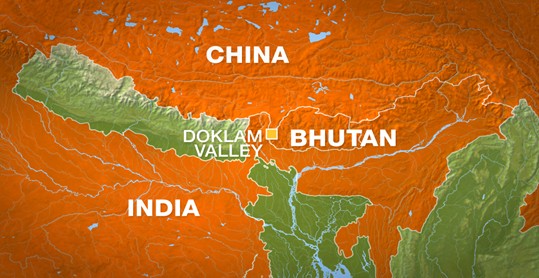
The Doklam standoff between China and India in 2017 is a significant example of China’s aggressive expansionism threatening regional stability in South Asia. The standoff occurred in a disputed tri-junction area between China, Bhutan, and India when China attempted to build a road through Doklam, territory claimed by Bhutan and supported by India.
The Doklam plateau comprises an 89 sq km of territory in western Bhutan, perched at an altitude of 4,000-4,500 meters, which is also claimed by China. The plateau is in the possession of Bhutan. India and Bhutan concur that the tri-junction of India, Bhutan and Tibet is on the north-western edge of the Doklam plateau, where the Batang La post of India is located. China, however, lays claim to the entire Doklam plateau.
On 8 June 2017, Chinese border guards moved into territory claimed by China and Bhutan, destroying two stone bunkers used by Bhutan’s army. On 16 June, about 70-80 Chinese personnel with bulldozers began road construction. Bhutanese troops failed to stop them, prompting Indian troops to intervene on 18 June, physically blocking Chinese soldiers, leading to a 73-day faceoff with no shots fired.
China’s strategy in South Asia operates on multiple interconnected fronts. Militarily, China fortifies disputed borders and leverages infrastructure projects like roads, railways, and logistic networks to improve force mobility and strengthen its strategic positions. China’s expansionist strategy in Doklam was consistent with its approach along its borders with India and in the South China Sea, where it uses infrastructure projects to solidify its claims.
The Doklam standoff is a part of a broader trend of Chinese territorial claims and invasions since the Sino-Indian War in 1962. A history of Chinese attempts to alter the status quo is highlighted by the 1967 clashes near Nathu La and Cho La, the 1986–1987 military mobilisation near the Tawang region of Arunachal Pradesh, and the conflicts in Daulat Beg Oldi (2013) and Chumar (2014). These flashpoints are accompanied by long-standing conflicts stemming from ill-defined borders left by the British colonial government, which have led to decades of unsolved negotiations and a lack of confidence.
China’s border and territorial strategies are driven not only by historical claims but also by broader geopolitical objectives. Control over key geographical points such as Doklam would give China strategic advantage over India’s Siliguri Corridor, a narrow land link to India’s northeastern states. Likewise, China’s Belt and Road Initiative and deepening ties with Pakistan militarize their relations with India and aim to encircle Indian influence in South Asia.
China issued multiple threats and warnings to India as part of its effort to challenge India’s intervention against Chinese road construction. Beijing accused India of violating Chinese sovereignty and interfering in China-Bhutan boundary talks. Chinese officials openly demanded India’s withdrawal, portraying India’s presence as illegal and provocative. China warned that continued Indian military presence would escalate tensions and destabilize regional peace and security. China deployed a significant number of troops and construction equipment, signaling its intent to solidify control. Beijing sought to pressure India through diplomatic denunciations, media propaganda, and increased military patrolling around the disputed tri-junction.
India retaliated with military force and diplomatic composure. India matched China’s force levels and held its ground without increasing the level of violence. India successfully protected regional interests and allies with its well-calculated show of resolve and forbearance during the 2017 Doklam conflict. In order to immediately face Chinese forces and stop additional incursion without resorting to firearms, Indian troops organised into a human chain. India’s dedication to protecting Bhutan, a close ally, and maintaining security in the crucial Siliguri Corridor was demonstrated by this forceful but restrained military presence.
The maturity, determination, resilience, and even-headedness demonstrated by India in the face of the aggressive, expansionist designs of its stronger adversary meant that it emerged geopolitically stronger from the Doklam stand-off. China’s image in the international arena, on the other hand, was dented by it. The Doklam standoff demonstrated that a determined state could withstand China’s three-warfare strategy—media, cyber, and legal—and that China is not the unstoppable force it claims to be. The patient and modest style of India’s diplomatic engagement, spearheaded by Foreign Secretary S. Jaishankar and National Security Advisor Ajit Doval, combined with steadfastness on the ground may have offered a new model for dealing with Chinese coercion.
India’s response in Doklam was a blend of military firmness, diplomatic prudence, and regional solidarity, effectively countering China’s aggressive tactics while preserving peace and stability in the volatile border region. The world has witnessed a more cohesive and consistent foreign policy approach from India. The Indian government has emphasized the significance of diplomatic dialogue and negotiation, which has helped to reduce tensions between the two countries.





Leave a Reply