
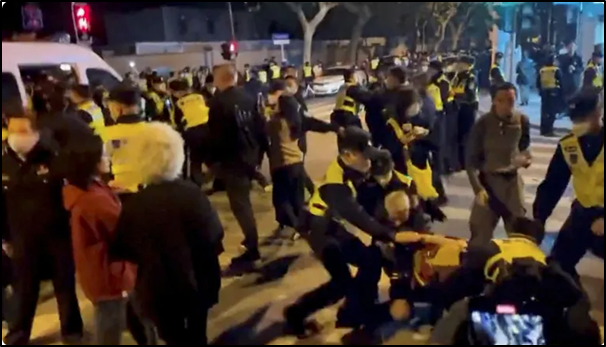
Four years ago, on 27 November 2022, Chinese authorities violently suppressed peaceful protests in Shanghai and other cities, marking a rare public challenge to the CCP’s harsh zero-COVID-19 lockdown policies. The protests, sparked by a deadly fire in Urumqi amid lockdowns, featured demonstrators holding blank papers and white flowers, chanting for freedom and an end to lockdowns. Police responded with mass arrests and forceful dispersal, while extensive online censorship blocked information. On this 4th anniversary, the protests remain a powerful symbol of resistance against government repression and Beijing’s relentless control over freedom of expression, despite censorship and fears keeping many from overt commemoration.The protests quickly spread nationwide amid a surge in COVID-19 infections driven by the highly transmissible Omicron variant. Cities including Beijing, Wuhan, Guangzhou, and Chongqing joined the unrest as citizens, exhausted after prolonged lockdowns (some exceeding 100 days), clustered in public spaces chanting for freedom and denouncing the zero-COVID strategy. Beijing saw over a thousand protesters along major roads chanting solidarity slogans like “We are all Shanghai people! We are all Xinjiang people!” while Wuhan residents destroyed barricades and overturned COVID testing tents. The unprecedented scale and boldness of protests threatened Beijing’s tightly controlled narrative, prompting brutal police crackdowns and arrests, often accompanied by heavy use of riot gear and surveillance to track dissenters.
According to the Reuters, China’s government defended its zero-COVID policy as life-saving and essential to prevent healthcare overwhelmed but remained steadfast in enforcement despite increasing criticism and economic impact. State media blackout on protest coverage and immediate deletion of social media posts related to demonstrations showcased Beijing’s unyielding grip on freedom of expression. Information controls extended to phone inspections for VPN use, monitoring messaging apps, and arresting protest organizers, revealing a multi-front effort to crush dissent. Supporters of protesters shared cryptic messages and visuals like photos of the “Wulumuqi Road” street sign to circumvent censorship and show solidarity covertly.
The events of late November 2022 highlighted widespread public anger not only against lockdown policies but also against the broader CCP governance perceived as unresponsive and oppressive. The protests invigorated a movement dubbed the “White Paper Protests” or “A4 Revolution,” referencing the blank sheets symbolizing censored speech. While forcibly suppressed, they reflected mounting societal frustrations in China’s major metropolitan centers and regions like Xinjiang, which faced some of the most stringent and longest lockdowns. The protests remain emblematic of Beijing’s heavy-handed government repression tactics including mass arrests, police violence, and relentless online censorship to maintain absolute control, especially over freedom of peaceful expression in China’s pandemic era.
As China faces ongoing public health challenges and economic pressures, the fourth anniversary of these protests serves as a somber reminder of citizens’ resilience and the risks they endure speaking out. The legacy of the 2022 anti-lockdown protests underscores the urgent need for greater respect for fundamental rights and freedom of expression in China.
India has played a positive role by highlighting these human rights abuses on global platforms and calling for freedom of expression and peaceful dissent in China. Indian civil society and media have expressed solidarity with the protesters’ demands for basic rights and freedoms. Conversely, China’s heavy-handed repression, widespread censorship, and disregard for human suffering reflect a negative image, contravening international norms and showing the government’s prioritization of control over citizens’ welfare and freedoms. The 4th anniversary of the 2022 anti-lockdown protests underscores the severe repression by Beijing’s regime, marked by mass arrests, police violence, and all-encompassing censorship. The crackdown revealed the government’s ruthless prioritization of control over human lives and freedoms amidst growing public anger and suffering caused by the zero-COVID policy. These actions starkly expose China’s authoritarian nature, where peaceful dissent is met with brutal force and information is aggressively suppressed to silence voices demanding basic rights and accountability.



Leave a Reply