
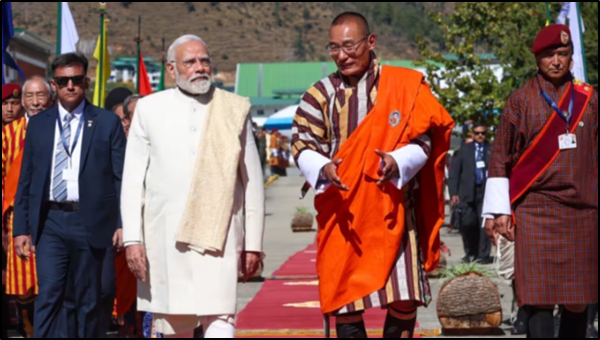
Prime Minister Narendra Modi’s recent visit to Bhutan came at a defining moment, as China intensifies efforts to expand its presence across the eastern Himalayas. The trip reinforced India’s strategic influence in the region and reaffirmed Thimphu’s confidence in New Delhi as its most dependable partner for stability, growth, and security. While Beijing continues its quiet courtship of Bhutan through talks and subtle pressure, Modi’s outreach clearly demonstrated that India remains Bhutan’s trusted ally.
During the visit, Modi and King Jigme Khesar Namgyel Wangchuck jointly inaugurated the 1,020-megawatt Punatsangchhu-II hydropower project a milestone in their enduring energy partnership. The project strengthens Bhutan’s role as a key supplier of clean electricity to India while ensuring a steady revenue stream for Thimphu. India also reiterated its commitment to complete the long-delayed Punatsangchhu-I project, reaffirming hydropower as both the backbone of Bhutan’s economy and a cornerstone of bilateral ties.
To further boost development, India announced a ₹4,000 crore concessional credit line for Bhutan’s infrastructure and energy initiatives. This complements the broader ₹10,000 crore assistance linked to Bhutan’s 13th Five-Year Plan and Economic Stimulus Programme. Agreements covering renewable energy, agriculture, healthcare and digital cooperation reflect India’s holistic approach one that prioritizes Bhutan’s people and prosperity alongside shared strategic interests.
Connectivity emerged as a major theme of the visit. Both sides agreed to expand road and rail networks linking Bhutan with Assam and West Bengal, including plans to connect Gelephu and Samtse to India’s railway grid. India will also set up an immigration check post at Hatisar to facilitate Bhutan’s flagship Gelephu Mindfulness City an ambitious sustainable urban project designed to attract investment and tourism. Supported by Indian financing and infrastructure, the project aims to integrate southern Bhutan more deeply with India’s markets and value chains.
On the digital front, India and Bhutan advanced their collaboration on integrating payment systems like the Unified Payments Interface (UPI), enabling seamless cross-border transactions. The move will help Bhutanese traders, students and travellers participate more fully in India’s digital economy, showcasing technology as a bridge that fosters regional economic integration.
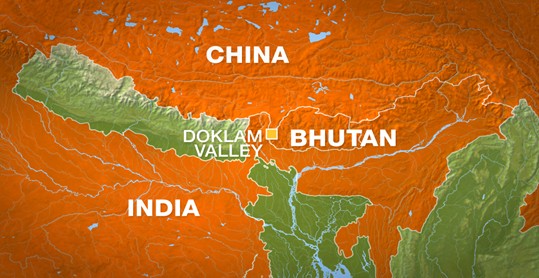
Strategically, the visit carries deeper significance. The sensitive Doklam plateau site of the 2017 India-China standoff remains a focal point at the tri-junction of India, Bhutan, and China, close to India’s vital Siliguri corridor. Beijing’s proposed three-step roadmap for border settlements, reportedly involving land swaps, seeks to expand Chinese proximity to this corridor an outcome India cannot accept for security reasons. By strengthening Bhutan’s economy and extending new development support, New Delhi is shielding it from coercive tactics and potential debt dependency.
For China, Modi’s visit is a diplomatic setback. Despite years of attempting to draw Bhutan into its orbit through negotiation and economic enticement, India’s proactive engagement demonstrates that Bhutan continues to value partnerships grounded in respect, equality and transparency. While Beijing may publicly downplay the visit, it will view the growing India-Bhutan partnership as limiting its room for manoeuvre in the Himalayas.
Bhutan’s preference for India is rooted in history and trust. From building schools and hospitals to roads and hydropower plants, India has long been a silent partner in Bhutan’s modernization offering open borders, educational exchanges, and economic aid without political strings. By contrast, China’s assertiveness, coupled with its infrastructure buildup along the disputed frontier, fosters caution among smaller neighbours. For Bhutan, India’s presence remains a guarantor of sovereignty and balance.
Modi’s visit reaffirmed a core regional truth: development based on mutual respect endures; influence built on coercion does not. As China’s expansionist posture unsettles its neighbours, India’s patient, partnership-driven approach continues to earn trust. Bhutan’s decision to deepen ties with India while maintaining dialogue with China reflects a pragmatic pursuit of stability, growth, and strategic autonomy in a contested Himalayan landscape.





Leave a Reply